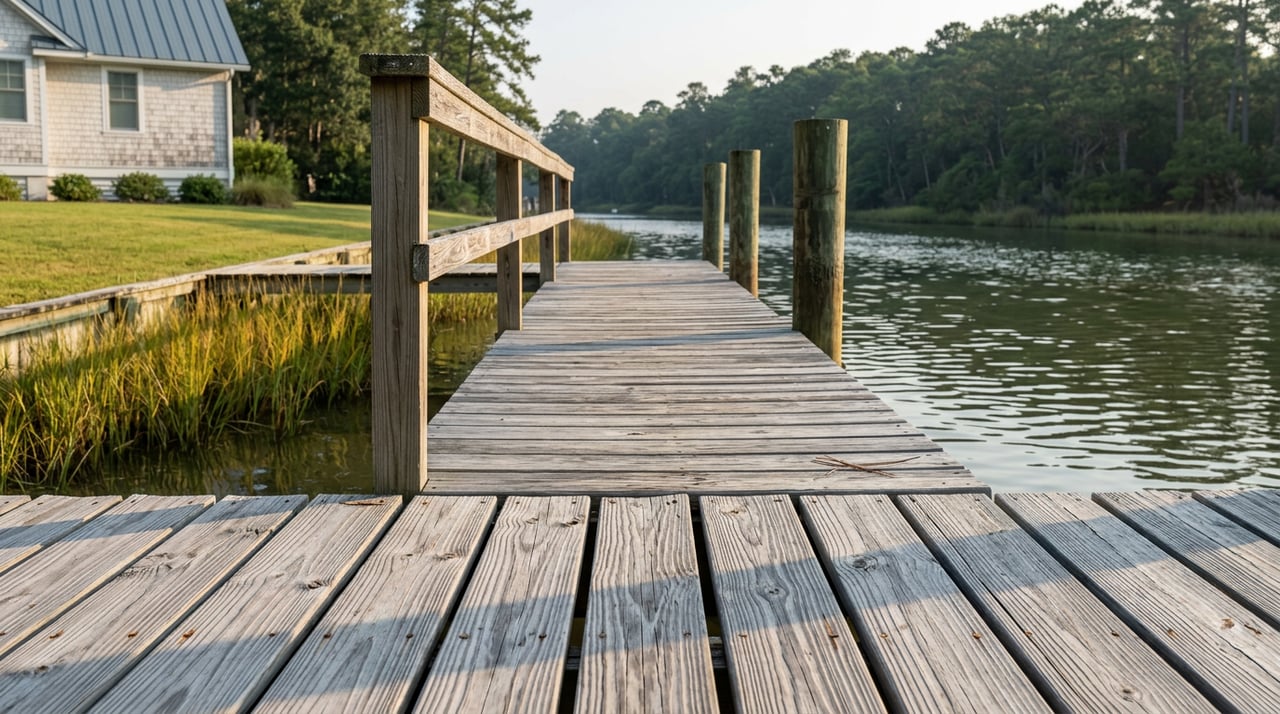
Buying Waterfront in White Stone? The Dock in the Photos May Not Be Yours to Keep
August 20, 2026
August 20, 2026
Two docks sit on the same parcel along Antipoison Creek in White Stone, installed within months of each other in 2025. One reaches two feet of water at mean low water. The other reaches three and a half. Same property, same shoreline, same listing photo caption calling it waterfront. A buyer comparing that listing to one on Dymer Creek or Carters Creek is not comparing like to like, even though every listing uses the same word.
That variance in depth is the easy part to explain. The harder part, the one that catches people off guard closer to closing, is that whoever built it might not have had permission to do so. According to Pender & Coward, in Virginia, that second problem does not stay with the person who built it. It follows the deed.
Water access in the Northern Neck runs through creeks with names like Antipoison, Dymer, Carters, and Tabbs before any of them reach the Rappahannock or the wider Chesapeake. Depth, protection from wind, and distance to open water change block by block, sometimes dock by dock. A listing that says waterfront tells you the lot touches water. It does not tell you whether a sailboat can get to open water at low tide or whether the same creek silts in every few years and needs dredging to stay usable.
This is worth confirming before an offer, not after one. Depth at mean low water, bottom composition, and whether a channel has been dredged recently are the kind of details a seller's disclosure will not always spell out unprompted, and they shape what the property is actually good for. A house bought for its dock is worth less if the dock cannot hold the boat the buyer already owns.
Virginia treats waterfront property rights the way it treats mineral rights in other parts of the country. They can be severed from the land and held separately. A parcel can change hands multiple times with its riparian rights quietly detached somewhere in the chain of title, meaning the current owner, and the buyer who comes after, has no legal right to build a pier at all, regardless of what the current dock looks like in photos.
Virginia is a caveat emptor state. Buyer beware is not a figure of speech here. Coastal Virginia Magazine put the practical version of this plainly: a buyer sees a pier with a boat tied up and imagines the fun ahead, then finds out after closing that the rights never came with the property.
The fix is not complicated, but it takes a step many buyers skip. A title search focused specifically on riparian rights, going back further than a standard residential title search typically covers, confirms whether those rights are intact. Anyone under contract on a waterfront parcel in White Stone should ask their title company directly whether this search was performed, not assume it was bundled into the standard package.
Here is the mechanism that surprises even experienced buyers. An unpermitted pier is a strict liability violation under Virginia law. That means intent does not matter. If the person who built the dock decades ago never filed a permit, and the current owner never knew, and you buy the house without knowing either, you are the one holding the violation the day it gets flagged.
This is not a theoretical risk in a region where docks have been built and rebuilt for a hundred years. Some structures predate regulation entirely. The Virginia Marine Resources Commission did not gain authority to regulate construction on state-owned bottomland until 1962, so a pier built before that date may be grandfathered in without a permit on file. A pier built in 1975 with no paperwork is a different situation, and it is the buyer, not the long-departed builder, who answers for it.
Before writing an offer on a property with an existing dock, ask the listing agent whether permit records exist and request the permit number if one was issued. Lancaster County's Land Use Office and the Virginia Marine Resources Commission both maintain records, and a quick records check is far cheaper than discovering the gap after closing.
If you plan to build, extend, or replace a dock after closing, the agency that reviews your application depends on precisely where the structure falls relative to two tidal benchmarks: mean high water and mean low water.
Effective September 1, 2025, the point of intake for that Joint Permit Application changed. Instead of filing with the Virginia Marine Resources Commission, applicants now submit through the Army Corps of Engineers' Regulatory Request System, which distributes the application to VMRC, the Department of Environmental Quality, and the local wetlands board. This was a federal mandate, not a state policy choice, and it is recent enough that plenty of guidance still floating around online describes the old process.
Layered on top of that, the Corps finalized its 2026 Nationwide Permits in January 2026, reissuing 56 of the 57 existing permits with limited changes and adding one new permit for fish passage projects. Those took effect March 15, 2026. For most homeowners building a standard residential dock, none of this changes what gets approved. It does change where the paperwork goes first and who is coordinating the review behind the scenes.
The practical number to plan around has not moved: according to Docks of the Bay Services, typical residential dock permits in the Northern Neck still take 60 to 90 days from submission to approval, longer if the site touches sensitive habitat like a seagrass bed. If you are buying with plans to build or replace a dock for a specific boating season, the smart move is filing in the fall or winter before the summer you want to use it, not in April when you are already impatient to get on the water.
Not every dock requires a full VMRC review. The Code of Virginia allows a general exception, often issued as a "No Permit Needed" letter, for structures that stay within specific limits:
Attorneys who handle these cases estimate that roughly 90 percent of piers built on state-owned bottomland in Virginia qualify for this exception rather than a full permit. That is good news for a buyer planning a modest, code-compliant replacement dock. It is not a substitute for confirming that an existing structure actually falls within those limits, since plenty of older docks were built before anyone was measuring against today's rules.
Can I ask the seller for the pier's permit history before I make an offer? Yes, and you should. Lancaster County's Land Use Office and VMRC both keep permit records searchable by property or by permit number, and a listing agent can often provide the permit number directly if one exists.
Does a grandfathered pre-1962 dock ever need anything on file? Not a construction permit, but it is worth asking your title company or a local closing attorney to note the grandfathered status in writing as part of the file, since informal grandfathering claims can be harder to prove decades later than a documented one.
Who do I call locally with questions before I write an offer? Lancaster County's Planning and Land Use Office handles permit applications and can direct you to the right form.
Waterfront buying in White Stone rewards people who ask about the water before they fall for the view. The creek depth, the permit history, and the chain of title behind the riparian rights matter as much as the porch and the kitchen, and they are far easier to sort out before you sign than after. If you are considering a waterfront purchase along the Rappahannock, Carters Creek, or any of the tidal creeks around White Stone, Middle Bay Realty can walk the specifics of a property with you before you write an offer, not after.
This article is general information, not legal, tax or financial advice. Consult a qualified professional about your situation.
Stay up to date on the latest real estate trends.


Experience a real estate partnership built on trust, expertise, and genuine care. We bring a lifelong understanding of what “home” truly means to every client and every decision.